
Searching “4 paws daycare” and finding results for pet boarding instead of childcare? You’re not alone. This mix-up happens constantly because many pet care facilities use animal-themed names that include “paws,” leading frustrated parents to dog daycare websites when they need a place for their kids. The confusion is real, and if you’ve clicked through expecting to find preschool information only to see photos of puppies playing, you need parent reassurance that this happens to everyone.
Here’s what’s going on: there’s no major childcare chain called “4 Paws Daycare.” What you’re encountering are primarily pet care centers with similar names. For instance, Pawsitive Day Care in Moncton, New Brunswick (open Monday through Friday, 7 am to 6 pm) is a dog daycare, not a facility for children. The animal-themed branding works great for pet businesses, but it creates a genuine headache for parents trying to navigate search results.
I remember frantically Googling daycare options when my daughter was a toddler, clicking through at least five pet grooming sites before realizing I needed to add “childcare” or “preschool” to my search terms. That small adjustment changed everything.
The good news? Once you know why this confusion exists, finding quality childcare becomes much easier. This guide will help you refine your search strategy, identify the red flags that signal you’ve landed on a pet facility, and evaluate actual childcare centers with confidence.
Why ‘4 Paws’ Usually Means Pet Care, Not Childcare
The pet care industry has developed its own distinct naming culture over the decades, and ‘4 paws’ sits right at its heart. Walk past any strip mall or commercial plaza, and you’ll likely spot animal-themed businesses: Paws & Claws Grooming, Happy Tails Boarding, The Barking Lot. These playful names immediately signal to pet owners that they’ve found the right place for their furry family members.
The ‘4 paws’ reference specifically celebrates dogs and cats, both of which have four paws (unlike our two-legged children). It’s become shorthand in the pet services world, appearing in thousands of dog daycares, veterinary clinics, grooming salons, and boarding facilities across North America. For instance, Pawsitive Day Care in Moncton uses this animal-centric naming approach to attract pet owners looking for dog daycare services.
Childcare centers, by contrast, tend to choose names that emphasize learning, growth, and childhood development. You’ll see names like Little Scholars Academy, Bright Beginnings Preschool, Sunshine Kids Learning Center, or Rainbow Room Daycare. These names speak directly to parents about education and nurturing, using language that connects with human developmental milestones rather than animal characteristics.
This naming divide exists for good reason. Each industry targets a completely different audience with different needs, concerns, and search behaviors. Pet owners respond to playful, animal-focused branding because they’re looking for a fun, safe environment for their dogs or cats. Parents searching for childcare respond to names emphasizing education, safety standards, and professional care for children. When you type ‘4 paws daycare’ into a search engine, you’re using the pet industry’s language, which is why your results keep pointing you toward dog daycares instead of the childcare center you actually need.
Understanding What You’re Really Looking For

I’ll never forget the morning I frantically typed “4 paws daycare near me” into Google while my toddler pulled every pot out of the kitchen cabinets. The first three results showed adorable puppies playing in spacious yards. I laughed, then groaned. I needed someone to watch my daughter, not my non-existent dog.
If you’re reading this, you’ve probably had a similar moment. Maybe you clicked on a listing for Pawsitive Day Care in Moncton, saw the photos, and thought “wait, those aren’t kids.” You’re not looking for doggy daycare at 12 Roy Brown St with 7 am to 6 pm hours, you need actual childcare for your actual child.
Here’s the thing: before you search again, take a moment to clarify exactly what you need. Are you looking for full-time care or drop-in options? Do you need infant care, toddler programs, or preschool? What hours work with your schedule? Knowing these specifics will help you search more effectively.
Instead of searching “4 paws daycare” or other animal-themed terms, try “licensed childcare center near me,” “daycare for toddlers [your city],” or “preschool programs in [neighborhood].” Add your location and age group for better results. If you’re looking for specific features, include those too: “daycare with outdoor play,” “Montessori childcare,” or “infant care with cameras.”
The clearer you are about your needs, the less time you’ll spend scrolling through pictures of golden retrievers when you should be touring actual daycare centers. Trust me, I learned that lesson while my daughter emptied the Tupperware drawer for the third time that morning.
Key Differences Between Pet Daycare and Child Daycare

Once you understand what you’re truly searching for, spotting the difference between pet and child daycare becomes straightforward. The facilities operate under entirely different frameworks, and recognizing these distinctions can save you time and prevent awkward phone calls.
The most immediate difference is licensing. Childcare centers must obtain state or provincial childcare licenses, which involve rigorous background checks, safety inspections, and ongoing compliance monitoring. Pet daycares, on the other hand, typically operate under business licenses with far less regulatory oversight. When you’re browsing a website or calling a facility, ask about their licensing body. If they mention a state Department of Children and Families or similar agency, you’ve found childcare. If they reference a local business bureau or veterinary association, it’s pet care.
| Aspect | Pet Daycare | Child Daycare |
|---|---|---|
| Licensing | General business license, minimal regulation | State childcare license with strict compliance |
| Staff Requirements | Animal handling experience, sometimes certification | ECE credentials, CPR/First Aid, background checks |
| Activities | Play yards, socialization, walks | Age-appropriate curriculum, developmental milestones |
| Safety Standards | Secure fencing, vaccination records | Child-proofing, evacuation plans, staff-to-child ratios |
| Typical Hours | Often 7am-6pm weekdays only | Extended hours, some weekend options |
Staffing tells the real story. Childcare workers need Early Childhood Education credentials, CPR and First Aid certification for infants and children, and must pass comprehensive background screenings. Pet daycare staff need experience handling animals and perhaps certification in dog behavior, but the bar is considerably lower. If a facility’s “About Us” page highlights teachers with degrees in child development, you’re in the right place.
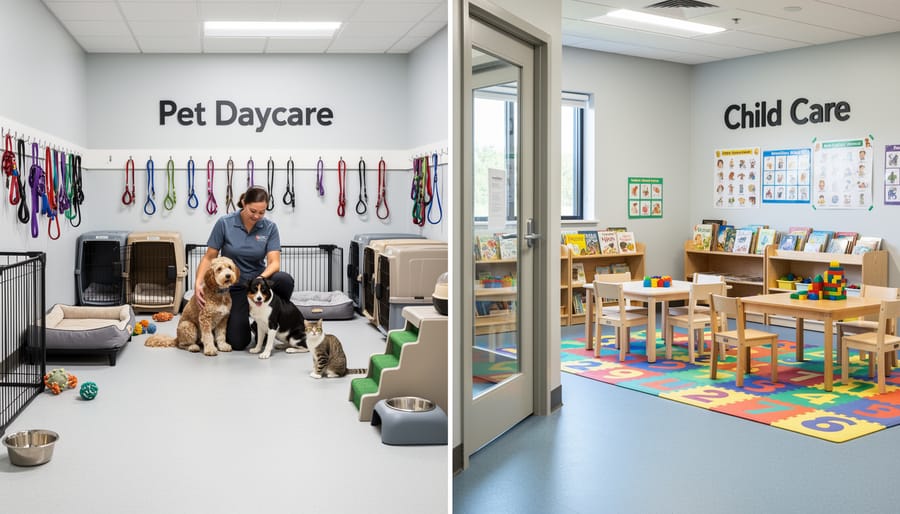
The activities and environment give visual clues too. Browse photos on their website or social media. Childcare centers showcase age-appropriate learning stations, small chairs and tables, educational toys, and reading corners. Pet daycares feature outdoor play yards, agility equipment, kiddie pools for dogs, and kennels. The smell alone would confirm which you’ve walked into, but you shouldn’t have to get that far.
Safety requirements differ dramatically. Childcare centers must maintain specific adult-to-child ratios, install safety gates and outlet covers, conduct fire drills, and follow strict medication administration protocols. Pet facilities focus on secure fencing, vaccination verification, and separating dogs by size or temperament. When you tour or call, the questions staff expect will immediately reveal which type of facility you’ve reached. They’ll either ask about your child’s age and developmental needs or your dog’s breed and energy level.
What to Look for in a Quality Childcare Center
Once you’ve refined your search and you’re looking at actual childcare centers, knowing how to evaluate them properly becomes crucial. I learned this the hard way during my first daycare tour when I showed up with no idea what questions to ask and left feeling more confused than when I arrived. Here’s what actually matters when you’re assessing whether a childcare facility is right for your family.
Start with licensing verification, which isn’t negotiable. Every legitimate childcare center must be licensed by your provincial or state authority. Ask to see their current license displayed prominently, and don’t hesitate to verify it online through your government’s childcare registry. Licensed facilities undergo regular inspections for health, safety, and program quality standards that protect your child.
Staff credentials deserve your close attention. Quality centers employ caregivers with early childhood education credentials, not just warm bodies who like kids. Ask about staff training in child development, first aid certification, and ongoing professional development. Staff turnover rates matter too, high turnover disrupts the consistent relationships young children need to thrive and often signals deeper workplace issues.
Safety protocols should be immediately visible during your tour. Look for secure entry systems that prevent unauthorized access, properly maintained equipment, clean and organized spaces, and age-appropriate safety measures like outlet covers and secured cabinets. Ask about their illness policies, emergency procedures, and how they handle accidents. Centers that can’t articulate clear safety protocols or seem defensive about questions should raise red flags.
The curriculum and daily structure tell you whether children are merely supervised or actually engaged in developmentally appropriate learning. Quality programs balance structured activities with free play, incorporate various learning domains, and adapt to individual children’s developmental stages. Ask how they support different learning styles and what a typical day looks like for your child’s age group.
Parent reviews and community reputation provide real-world insight beyond the polished tour. Search online reviews, but read critically, one angry review might reflect a personality clash rather than systemic problems, while patterns of similar complaints deserve attention. Better yet, ask current parents directly if you spot them during pickup. Most are happy to share honest feedback.
Trust your gut during tours. If something feels off, whether it’s how staff interact with children, the overall atmosphere, or how your questions are answered, pay attention to that instinct. The right childcare center should leave you feeling confident, not anxious. Finding quality care takes time and effort, but it’s worth it so you can avoid sleep deprivation from worrying about whether your child is safe and happy while you’re at work.
Questions to Ask Before Enrolling Your Child
Walking into a childcare center for the first time can feel overwhelming. You’re trying to absorb everything while keeping your toddler from climbing the bookshelf, and it’s easy to forget the important questions. I learned this the hard way during my first daycare tour, when I left realizing I’d forgotten to ask about their sick child policy.
Start with staff-to-child ratios, which directly impact how much attention your child receives. Ask what the ratio is for your child’s age group and whether they maintain it throughout the day, not just during official hours. Find out how they handle staffing when someone calls in sick. A center that struggles with last-minute coverage might suddenly have one teacher managing twice as many children.
Emergency procedures matter more than you might think. Ask how they handle medical emergencies, what their evacuation plan looks like, and how they communicate with parents during crises. Request details about their illness policy: at what temperature do they send children home, and how long must kids stay home after common illnesses? These seemingly small details become crucial when you’re juggling work deadlines and a feverish toddler.
Communication methods vary widely between centers. Some send daily photos and updates through apps, while others rely on brief conversations at pickup. Ask how teachers share information about your child’s day, particularly meals, naps, and behavior. If your child experiences an afternoon slump at certain times, you’ll want to know their nap schedule and whether they can accommodate practical sleep strategies that work for your family.
What staff qualifications should I look for in a childcare center?
Look for teachers with early childhood education credentials and current CPR and first aid certification. Many quality centers also require ongoing professional development training.
How do I know if a childcare center’s discipline approach matches my values?
Ask directly about their behavior management philosophy and request specific examples of how they handle common situations like hitting or tantrums. Their answers should align with positive guidance techniques rather than punitive measures.
Should I be concerned if a childcare center has high staff turnover?
Yes, frequent staff changes can disrupt your child’s sense of security and continuity of care. Ask how long current teachers have been there and why previous teachers left.
Daily schedules reveal a lot about a center’s priorities. Request a typical day’s timeline and notice how much time goes to structured activities versus free play. Ask about outdoor time, screen use policies, and whether they accommodate different learning paces. Some children thrive with lots of structured activities, while others need more open-ended exploration.
Don’t skip practical questions about drop-off and pickup procedures, late fees, vacation policies, and what happens during weather closures. These logistics might seem boring compared to curriculum discussions, but they’ll affect your daily life significantly once you’re enrolled.
If you’ve found yourself clicking through search results for ‘4 paws daycare’ only to land on websites full of wagging tails and doggy play areas, you’re definitely not alone. This mix-up happens to parents every single day, and there’s nothing embarrassing about it. The pet care industry loves animal-themed names, which means your childcare search can sometimes take you down some unexpected paths. The important thing is that you now know what to look for and how to tell the difference at a glance.
Finding the right childcare center for your family takes time, and that’s perfectly okay. There’s no rush to settle on the first facility you find. Take your time touring different centers, asking questions, and trusting your instincts about what feels right for your child. The effort you put into this search now will pay off in peace of mind later.
We’d love to hear about your own daycare search experiences. Did you encounter any confusing business names or funny mix-ups along the way? What tips helped you find the perfect fit for your family? Share your stories and advice in the comments below. Your experience might be exactly what another parent needs to hear as they navigate their own search. We’re all in this together, and the Snuggle Mama community is here to support you every step of the way.